
2026 is the 100th anniversary of Route 66, which makes this the year to figure out the real cost to do Route 66 end-to-end. The Mother Road runs 2,448 miles from Chicago to Santa Monica through eight states — Illinois, Missouri, Kansas, Oklahoma, Texas, New Mexico, Arizona, and California. A couple can drive the whole thing in 14 days for $2,000–$3,300 total, or about $1,000–$1,650 per person. That includes gas, motels, food, and the entry fees for everything you’d actually want to stop at. Here’s exactly where every dollar of the cost to do Route 66 goes.
This post contains affiliate links. If you purchase through our links, we may earn a small commission at no extra cost to you — thanks for supporting TravelCheapUS!
The Route and How Long It Takes
The route splits into a few realistic pacing options. 10 days is the bare minimum and you’ll skip a lot. 14 days is the standard, hits every must-see, and lets you do roughly 175 miles a day with real time at the stops. 21 days is the dream pace — small towns, two nights in Albuquerque and Flagstaff, and time to do detours like the Grand Canyon. Most budget travelers land at 14 days.
Drive west. Chicago to Santa Monica is the traditional direction, the sun rises behind you so morning driving is easy, and the landscape gets steadily more dramatic the further you go — from Illinois farmland to Painted Desert to the Pacific. East-to-west also ends at a beach, which is a much better celebratory finish than a Chicago parking garage.
Gas: The Biggest Single Variable
At 2,448 miles plus side trips (call it 2,700 total), a car getting 28 mpg at $3.50/gallon average runs you about $340 in gas. Drop to an SUV or older car getting 18 mpg and the same trip jumps to $525. The single biggest budget lever on Route 66 is the vehicle. If you’re renting, pick a compact — you’ll save $200–$400 in gas on the full trip, plus another $20–$40/day at the rental counter.
Gas is consistently cheapest in Oklahoma, Texas, and New Mexico, and most expensive in California. Fill up just before crossing into California and you’ll save real money on the final 300 miles.
Where to Stay: Historic Motels Are the Move
The cost to do Route 66 the right way means sleeping in the iconic vintage motels, and the budget news is they’re not that expensive. Most run $60–$110/night for a double in 2026. The ones worth planning around:
- Wagon Wheel Motel (Cuba, MO) — $75–$95/night, beautifully restored 1934 cottages
- Boots Court Motel (Carthage, MO) — $90/night, Clark Gable allegedly slept here
- Blue Swallow Motel (Tucumcari, NM) — $100–$135/night, neon at night that’s worth the price alone
- Roadrunner Lodge (Tucumcari, NM) — $80–$110/night, cheaper alternative on the same strip
- El Trovatore Motel (Kingman, AZ) — $70–$95/night, original 1939
- Wigwam Motel #6 (Holbrook, AZ) — $85–$110/night, you sleep in a concrete tipi, books out a year in advance
- Munger Moss Motel (Lebanon, MO) — $70–$90/night, family-run since 1946
If you want to save further, plain chain motels in Tulsa, Amarillo, Albuquerque, and Flagstaff run $60–$90/night and are the cheapest beds along the route. Compare rates in Tucumcari or Amarillo on Booking.com.
For the cheapest option, mix in 2–3 nights of camping. Cherokee Hills (OK), Palo Duro Canyon State Park (TX, $26/night, stunning), and the various Arizona state parks all sit close to or right on Route 66 and drop your nightly cost to $25–$35.
Food Costs on the Mother Road
Route 66 food is part of the experience — classic diners with $10 breakfasts and $14 burger plates. A realistic average for 14 days is $45–$60 per person per day if you eat out for most meals, or $25–$35 per person per day if you cooler-pack breakfasts and lunches and only sit down for dinner. The smart play: groceries for breakfast and lunch (cereal, sandwiches, fruit, drinks), then save your money for one great diner each night.
Diners worth the splurge: Lou Mitchell’s (Chicago, the official Route 66 start), Big Texan Steak Ranch (Amarillo, free 72-oz steak if you finish it in an hour), Snow Cap Drive-In (Seligman, AZ, the inspiration for Cars), and Mr. D’z Route 66 Diner (Kingman, AZ). Budget $18–$25 per person at each.
What to See (Most of It Is Free)
Here’s the underappreciated truth: most of the iconic Route 66 attractions cost nothing. That single fact keeps the total cost to do Route 66 reasonable even on a strict budget.
Free stops: Cadillac Ranch (Amarillo, TX), Standin’ on the Corner park (Winslow, AZ), Hackberry General Store (AZ), the Blue Whale of Catoosa (OK), the Gemini Giant (Wilmington, IL), Route 66 Midpoint sign (Adrian, TX), Painted Desert overlooks, and the Santa Monica Pier finish line. The neon signs of Tucumcari at night are free street-art viewing.
Paid stops worth the money: Meteor Crater (AZ, $30/adult), Petrified Forest National Park (AZ, $25/vehicle — or free with America the Beautiful Pass), Grand Canyon side trip from Williams (AZ, $35/vehicle — see our full breakdown of what a Grand Canyon visit costs), and the Route 66 Museum in Clinton, OK ($7).
Sample Budget: The Real Cost to Do Route 66 for Two
Here’s a realistic 14-day Chicago to Santa Monica trip for two people sharing a compact car:
| Expense | Cost |
|---|---|
| Gas (2,700 miles, 28 mpg, $3.50 avg) | $340 |
| Motels (11 nights × $85 avg) | $935 |
| Camping (3 nights × $28 avg) | $85 |
| Groceries + cooler food (14 days, 2 people) | $420 |
| Diners and dinners out (10 meals, 2 people) | $440 |
| Attraction entries (Meteor Crater, Petrified Forest, Grand Canyon, museums) | $160 |
| Misc (parking, souvenirs, coffee) | $120 |
| Total | ~$2,500 for two (~$1,250/person) |
That’s the actual cost to do Route 66 over two weeks — $1,250 per person with iconic motels, hot meals, and every major paid attraction included. Camp more nights and cook every meal and you can pull the total down to ~$1,800 for two ($900/person). Splurge on lodges and three sit-down meals a day and you’re at $4,000+. The flying-in surcharge is roughly $200–$400 each for airfare to Chicago and home from LAX, plus another $400–$800 for a one-way car rental.
Tips for Cutting the Cost to Do Route 66
Book the iconic motels early. With 2026 being the Route 66 centennial, places like the Wigwam and the Blue Swallow are filling up months in advance — book the moment you have dates. The walk-up rates won’t exist this summer.
Drive your own car if you can. A one-way rental from Chicago to Los Angeles runs $700–$1,500 with drop fees, vs. driving your own vehicle for the cost of gas alone. If you’re flying home, the math sometimes still works in favor of driving back — a 3-day return drive on the interstate is cheaper than a one-way rental plus airfare for two.
Buy the $80 America the Beautiful Pass. It covers Petrified Forest and the Grand Canyon, both on Route 66 detours. Two parks visit and it’s already paid for itself.
Use a portable cooler from day one. Stock up at a grocery store in Chicago and again in Albuquerque. Breakfast and lunch from a cooler over 14 days saves a couple roughly $400. That’s a Wigwam Motel night plus the Meteor Crater for free.
Skip the bigger cities for sleep. Chicago and LA hotels run $200–$400/night. Book one night at the start and one at the end and spend the rest in the small towns where motels are $75. If your itinerary lets you, sleep in the suburbs of both ends to dodge city pricing.
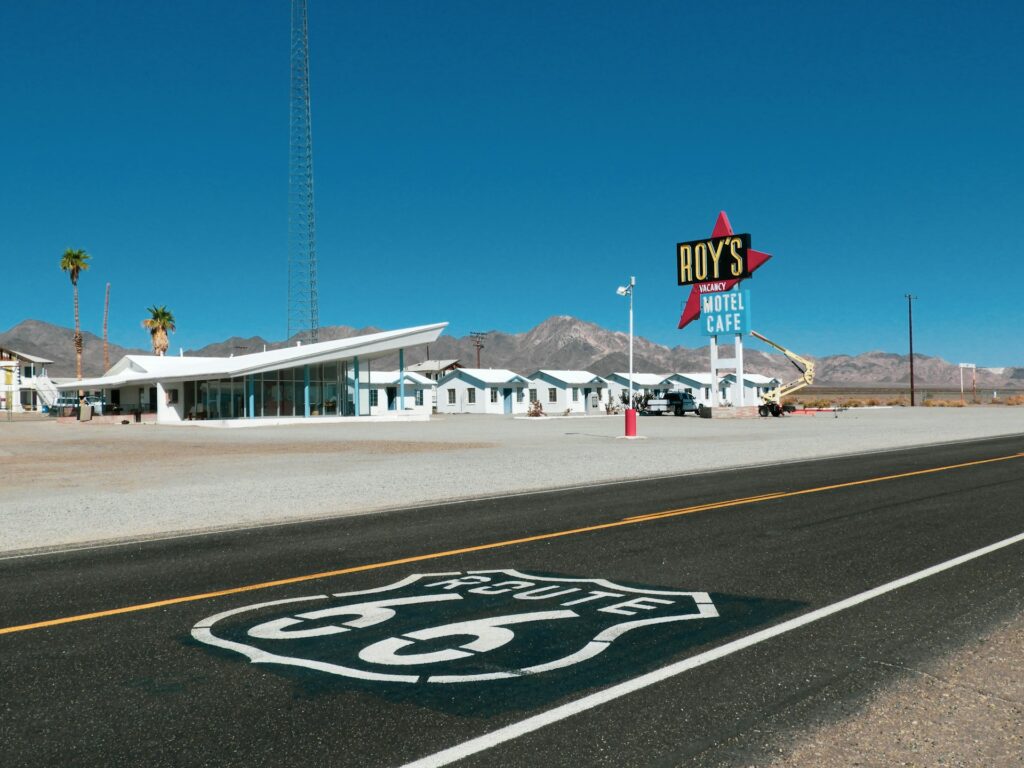
Photo by Michelle Oude Maatman on Unsplash