
The Pacific Coast Highway on a budget is a real thing in 2026 — and this is finally the year to do it. Highway 1 through Big Sur fully reopened in January after almost three years of landslide closures, which means the entire 442-mile San Francisco to Los Angeles drive is open again for the first time since 2023. You don’t need to drop $4,000 on this trip. With a tent, a cooler, and a smart route, a couple can cover the whole coast in 5 days for around $700 total. Here’s exactly how to do the Pacific Coast Highway on a budget without skipping any of the iconic stops.
This post contains affiliate links. If you purchase through our links, we may earn a small commission at no extra cost to you — thanks for supporting TravelCheapUS!
Drive North to South
The single biggest tip for the Pacific Coast Highway on a budget — or any budget — is direction. Drive San Francisco to Los Angeles, not the other way around. Heading south puts you on the ocean side of Highway 1, which means every pull-off, every photo stop, every “wait, look at that” moment is a simple right turn instead of a left turn across two lanes of traffic. You’ll see more, stop more often, and burn less gas pulling U-turns to chase missed views. The 5-day itinerary below assumes north-to-south.
Day 1: San Francisco to Santa Cruz (~75 miles)
Start with a free morning in San Francisco — walk the Golden Gate Bridge, wander Golden Gate Park, grab a $10 burrito in the Mission. Then point south. The drive to Santa Cruz is short, which leaves time for the best free stop of the day: Pacifica State Beach for surf-watching, or the cliffs at Devil’s Slide. In Santa Cruz, the boardwalk itself is free to walk (rides cost extra), the wharf is free, and West Cliff Drive at sunset is the kind of scene people pay for at resort hotels.
Where to sleep: Santa Cruz hotels run $130–$220/night in summer. If you’re car-camping, drive 10 miles inland to New Brighton State Beach ($35/night) for ocean-view sites without the city prices.
Day 2: Santa Cruz to Monterey/Carmel (~50 miles)
Cruise down through Moss Landing (cheap fish tacos, sea otters in the slough for free), into Monterey. Cannery Row and the wharf are free to walk. The Monterey Bay Aquarium is $60 — skip it unless it’s a bucket-list item; you can see otters and seals for free from the public viewing platform just outside. 17-Mile Drive through Pebble Beach charges $12 per car — gorgeous but skippable. Carmel-by-the-Sea is fully free to wander, and Carmel Beach is one of the prettiest in California. For a fuller list of free things to do in the area, see free and cheap things to do in Monterey on our companion directory.
Where to sleep: Monterey hotels are pricey ($180–$320). Cheaper options sit 20 minutes inland in Salinas ($90–$140). For camping, Veteran’s Memorial Park Campground right in Monterey is $35/night and walkable to downtown — a steal.
Day 3: Big Sur (~70 miles)
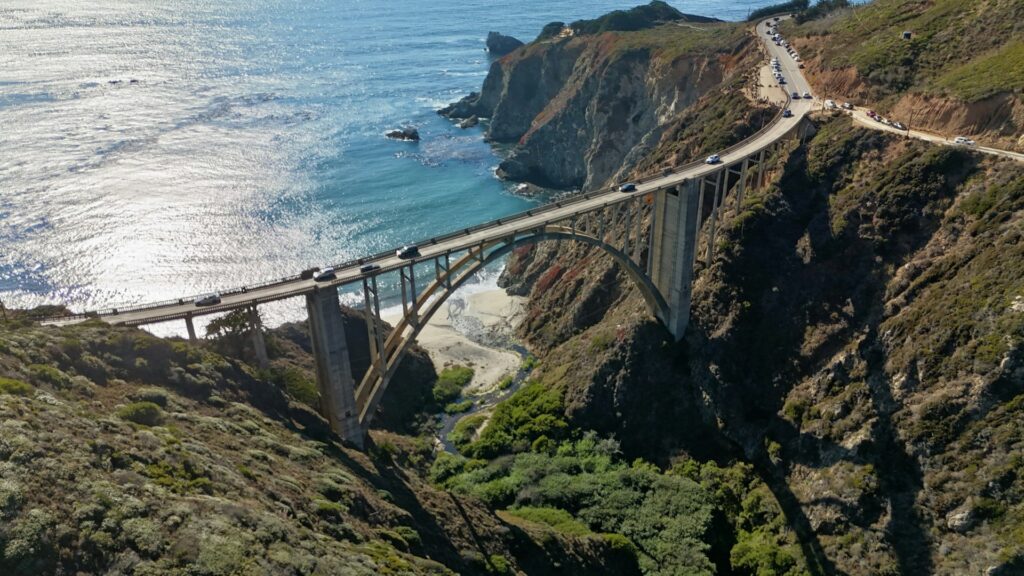
This is the day you came for. The full Big Sur stretch is finally drivable again after the multi-year Regent’s Slide closure, and there’s no part of the Pacific Coast Highway on a budget that delivers more drama. Hit the stops in order: Garrapata State Park (free roadside hiking and cliff trails), Bixby Creek Bridge (free pull-off on the north side gives the iconic shot), Point Sur Lighthouse (visible from the road, free), Pfeiffer Big Sur State Park ($10 day-use parking but redwood hikes worth it), and Pfeiffer Beach (the purple-sand beach — the access road is narrow and unmarked, look for an unsigned left turn south of the lodge).
Don’t miss McWay Falls in Julia Pfeiffer Burns State Park. There’s a paid overlook inside the park ($10 parking), but the same view is available from a free pullout on Highway 1 just before the park entrance — locals call it the “free overlook.” Park there.
Where to sleep: Big Sur lodges run $400–$900/night — not happening on a budget. The play is camping. Plaskett Creek ($45/night, oceanfront) and Kirk Creek ($45/night, on the cliff edge) are two of the most spectacular campgrounds in America. Book exactly six months in advance on Recreation.gov; summer weekends sell out in minutes.
Day 4: Big Sur to San Luis Obispo (~110 miles)
Pull over at the Piedras Blancas elephant seal rookery just north of San Simeon — it’s completely free, has a boardwalk and rangers, and you’ll see hundreds of elephant seals lounging on the beach. Hearst Castle is $35–$45 per person for tours; skip it for the free roadside view if you’re tightening the belt. Morro Bay with Morro Rock is a great free stop for lunch and photos.
Where to sleep: San Luis Obispo and Pismo Beach are the cheapest stretch of the whole drive. Budget motels start at $79/night in Pismo. Compare current rates on Pismo Beach hotels. Pro tip: Monday and Tuesday nights run 30–40% cheaper than weekends in this area. While you’re in town, see free things to do in San Luis Obispo on our companion directory.
Day 5: San Luis Obispo to Los Angeles (~190 miles)
The longest driving day, but the stops are tight. Detour into Solvang (free to wander the Danish-style village; coffee and a pastry under $10). Cruise through Santa Barbara — State Street, the historic Mission, and East Beach are all free. Malibu — pull off at El Matador State Beach (small parking fee) for the rock formations. End at the Santa Monica Pier where Route 66 traditionally ends and Highway 1 keeps going.
Sample Budget: The Pacific Coast Highway on a Budget for Two
| Expense | Cost |
|---|---|
| Gas (442 miles + side trips, ~28 mpg) | $95 |
| Camping 3 nights (Plaskett + Veteran’s + New Brighton) | $115 |
| Motel 1 night in Pismo Beach | $85 |
| Groceries and cooler food (5 days, 2 people) | $140 |
| 2 dinners out + coffees/snacks | $140 |
| Pfeiffer + Hearst Castle entries (optional) | $80 |
| SF parking + miscellaneous | $60 |
| Total | ~$715 for two (~$358/person) |
If you skip Hearst Castle and Pfeiffer parking and pack every meal, the same trip drops to ~$590 for two. If you hotel every night instead of camping, add roughly $500. The Pacific Coast Highway on a budget is fully achievable; the choice is whether you sleep with the surf or in a Best Western.
More Tips for the Pacific Coast Highway on a Budget
Rent a small economy car, not an SUV. The roads are narrow, the views are the same, and you’ll save $20–$40/day plus burn 25% less gas. A compact also fits the tight Big Sur turnouts better than a full-size.
Stock the cooler in San Francisco or Salinas. Once you’re in Big Sur, gas is $7+/gallon and groceries are 50% more expensive than anywhere else in California. Buy 5 days of sandwiches, fruit, drinks, and snacks before you leave the Bay Area, pack them in a portable cooler, and use the dozens of cliffside picnic pullouts as your daily dining room.
Gas up before the climb. The cheapest gas on the route is in Salinas, San Luis Obispo, and Ventura. The most expensive is in Big Sur itself, then Carmel, then Malibu. Fill up at the cheap stops and avoid the cliff-edge stations unless it’s an emergency.
Check road conditions every morning. Highway 1 through Big Sur is fully open as of January 2026, but winter storms still cause short closures. Bookmark the Caltrans road conditions page and check it before each driving day.
Drive Big Sur in daylight. The road has no streetlights for 80+ miles, the turns are tight, and night driving turns the prettiest part of the trip into white-knuckle stress. Plan to be off Highway 1 between Carmel and San Simeon before dark.
Photo by Rodrigo Kammer on Unsplash