The cost to visit Yellowstone is surprisingly affordable if you know what you’re doing. Yellowstone is the original national park, the size of Connecticut and Rhode Island combined — and a solo traveler can do a 3-day camping trip for around $200. A couple can swing the same trip for $350–$450. A family of four can do it for $500–$650, including gas. Here’s exactly where every dollar of the real cost to visit Yellowstone goes.
This post contains affiliate links. If you purchase through our links, we may earn a small commission at no extra cost to you — thanks for supporting TravelCheapUS!
Entry Fees
The biggest single line item in the cost to visit Yellowstone is the entry fee. The park charges $35 per vehicle for a 7-day pass — that covers everyone in the car, so a family of five pays the same as a solo driver. Motorcycles are $30. Walk-ins and bicyclists are $20 per person. The same pass also gets you into Grand Teton National Park to the south, which is one of the best two-for-one deals in the National Park Service.
If you’re visiting more than one national park this year, the America the Beautiful Annual Pass at $80 is the smarter buy. It covers unlimited entry to all 400+ federal recreation areas for a full year. A Yellowstone trip plus any second park visit pays for it — and most Yellowstone trips already include Grand Teton, so you’re effectively two parks in. Buy it at the entrance gate or order it in advance at store.usgs.gov.
Getting There
Yellowstone has five entrances spread across two states, and which one you use changes everything about the trip. The West Entrance at West Yellowstone, MT is the busiest and closest to the most popular geyser basins. The North Entrance at Gardiner, MT is the only entrance open to vehicles year-round. The East Entrance at Cody, WY is the quietest. The South Entrance connects directly to Grand Teton and Jackson, WY.
The closest airports are Bozeman, MT (BZN), about 90 miles from West Yellowstone and 80 miles from Gardiner; Jackson Hole, WY (JAC), about 60 miles from the South Entrance; and Idaho Falls, ID (IDA), about 105 miles from West Yellowstone and usually the cheapest of the three to fly into. Rental cars typically run $40–$70/day. Most visitors drive in — expect $60–$150 in gas depending on your starting point and how much you drive once inside the park (the Grand Loop alone is 142 miles).
Where to Stay
Inside the park, camping is the budget play. The seven NPS-managed campgrounds (Mammoth, Indian Creek, Norris, Tower Fall, Pebble Creek, Slough Creek, Lewis Lake) run $20–$25/night and book through Recreation.gov up to 6 months in advance. Mammoth is the only one open year-round. The five concessionaire-run campgrounds (Madison, Canyon, Bridge Bay, Grant, Fishing Bridge RV) cost $35–$50/night and book through Yellowstone National Park Lodges. Summer weekends sell out the day reservations open — book the moment they release.
The park’s historic lodges (Old Faithful Inn, Lake Yellowstone Hotel, Mammoth Hot Springs Hotel) are spectacular but run $200–$500+/night — not a budget move unless you nab one of the cheaper cabin rooms a year out.
Outside the park, your four main gateway towns are very different in price. Gardiner, MT (North Entrance, $90–$160/night) is the budget winner — small, quiet, and right at the gate. West Yellowstone, MT (West Entrance, $140–$260/night peak) is the most convenient for the geyser basins but charges peak-tourism prices. Cody, WY (East Entrance, $90–$170/night) is the quietest gateway and 50 miles from the entrance — great if you want to combine Yellowstone with the Buffalo Bill museum. Jackson, WY (South Entrance, $180–$400/night) is gorgeous but the most expensive option in the region.
Compare current rates for hotels in Gardiner, West Yellowstone, or Cody on Booking.com to see what’s available for your dates.
Planning a stop in Bozeman or Jackson before or after the park? See our companion budget directory for free things to do in Bozeman and free things to do in Jackson.
Food Costs
Food inside the park is expensive and the options are limited. A sit-down meal at one of the lodge dining rooms runs $25–$40 per person. A burger and fries at a cafeteria is $18–$22. A sandwich from a general store is $12–$15. Coffee is $5. Three meals a day eating in-park easily hits $60–$80 per person.
The budget move is to bring everything yourself. Stock up at a grocery store in Bozeman, Livingston, or Idaho Falls before you arrive, pack a portable cooler with sandwiches, snacks, and drinks, and use the picnic areas scattered throughout the park (there are dozens). Every developed campground has fire rings and bear-proof food storage. Doing this cuts your daily food spend from $60–$80 per person down to $12–$18.
What to Do (Most of It Is Free)
This is where Yellowstone really delivers for budget travelers — once you’re inside, almost every iconic experience costs nothing. That single fact is what keeps the total cost to visit Yellowstone so manageable for everyone from solo travelers to families of four.
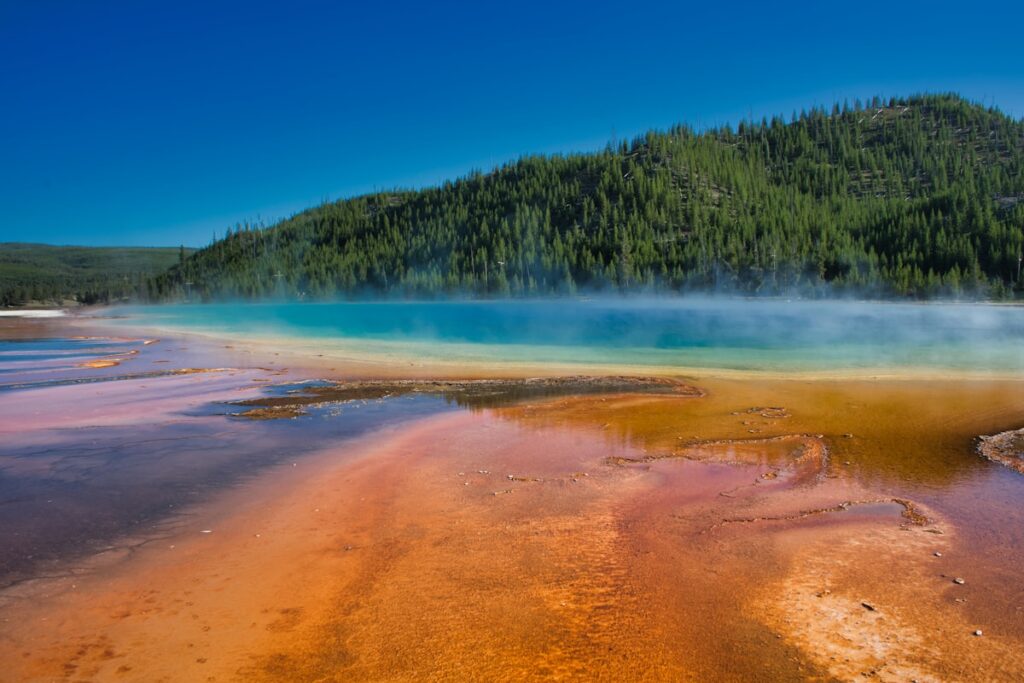
Old Faithful erupts roughly every 90 minutes, all day, every day, completely free. The boardwalks around the Upper Geyser Basin connect more than 150 active geysers and hot springs — the highest concentration on Earth. Grand Prismatic Spring, the postcard rainbow pool, is free; the half-mile Fairy Falls overlook trail gives you the best aerial-style view without paying for a helicopter. Mammoth Hot Springs terraces, the Grand Canyon of the Yellowstone with Lower Falls, and Lamar Valley wildlife viewing (often called America’s Serengeti for good reason) are all free.
Ranger-led talks, geology walks, and evening campfire programs happen daily at multiple visitor centers and amphitheaters — check the park newspaper handed out at the entrance for that day’s schedule.
The paid experiences — guided wildlife tours ($150–$300/person), boat rentals on Yellowstone Lake ($15–$60/hour), and the historic Yellow Bus tours ($95–$135/person) — are entirely optional. You can spend three full days in Yellowstone and pay nothing for activities beyond the entry fee.
The Real Cost to Visit Yellowstone: Sample Budget
Here’s a realistic 3-night camping trip to Yellowstone for two people:
| Expense | Cost |
|---|---|
| Entry fee (vehicle pass) | $35 |
| NPS campground (3 nights × $25) | $75 |
| Gas (Bozeman round trip + driving the Grand Loop) | $80 |
| Groceries and food (3 days, 2 people) | $90 |
| One dinner out in Gardiner or West Yellowstone | $50 |
| Total | ~$330 for two (~$165/person) |
That’s the actual cost to visit Yellowstone for a 3-night camping trip — under $170 per person with everything included. For a family of four, double the food budget and add roughly $25–$50 for the second campsite if you need it. You’re looking at $500–$600 for the same trip. If you already have an America the Beautiful Pass, subtract $35 from both totals. Add another $200–$400 if you fly in and rent a car.
Tips for Cutting the Cost to Visit Yellowstone
Visit in shoulder season. Late May through mid-June and the second half of September are the sweet spots — bison and bear are active, crowds are manageable, and gateway-town lodging drops 30–50% from peak summer rates. July and August are gorgeous but packed; expect bumper-to-bumper traffic at every wildlife sighting and full campgrounds for months.
Book campsites the day reservations open. Set a reminder exactly 6 months before your target dates. Summer weekends at popular campgrounds sell out within hours. The $20–$25/night rate at NPS-run sites is a fraction of any hotel within an hour’s drive — don’t lose it by waiting.
Base yourself in Gardiner, not West Yellowstone. West Yellowstone charges peak-tourism prices for average hotels and average food. Gardiner is just as close to a major entrance, has half the crowds, and costs 30–40% less. Browse Gardiner hotels on Booking.com for current rates.
Plan the Grand Loop strategically. The figure-8 road system is 142 miles and takes 4–7 hours of driving without any stops. Don’t try to see it all in one day. Pick the lower loop one day (geysers and hot springs) and the upper loop another day (canyon, Lamar Valley, Mammoth) so you’re not burning gas backtracking.
Be out at sunrise. Wildlife viewing in Lamar Valley is best in the first two hours after sunrise — when wolves, bears, and bison are most active and tour buses haven’t shown up yet. Old Faithful eruptions before 8am have a fraction of the crowd. The early start that feels painful at 5:30am will be the highlight of your trip.
Photo by Don Kawahigashi on Unsplash